Digital Art and Drawing
In 1935, in The Work of Art in the Age of Mechanical Reproduction Walter Benjamin develops the theory that the work of art has lost its will because of its easy reproducibility by modern means such as printing or photography.
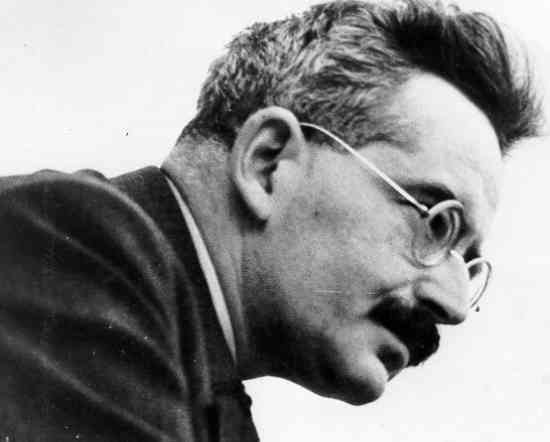 W alter Benjamin
However, well before the twentieth th century, the use of etching - whether to popularize existing paintings or to form new autonomous works - already well under way this will, by demystifying the art for desecrating and accessible, not to classes, but the middle classes s 'imposed, who learned to consume facing an aristocracy whose financial means made it less and less able to consume [1] . It is not surprising that the etching has been developed more rapidly in societies in which a wealthy bourgeoisie has quickly established: Holland, the Rhine, among others.
The debate is not new. It has been accentuated by the development of color lithography and the appearance of photography, first as a means of reproduction and distribution, then as modes of artistic expression had gained their independence. This how digital technologies challenge us to create not so much the status of the aura of the work, although undermined by Dada, Pop Art, Art Brut, the Arte Povera or minimalism, that notions of property and compensation for their creators.
There is, indeed, an essential difference between etching, lithography and photography classic, first, and digital arts, on the other. In the first, production from any copy of the artifact requires the setting implement a process of materialization that uses a matrix - a photographic negative, stone lithography, plate of copper or zinc - and at a substrate - the paper or, sometimes, the canvas -. Whoever has the matrix - say, for simplicity, the creative artist or their beneficiaries - has the opportunity, through the acquisition of technical skills or the use of a technician, to multiply the work.
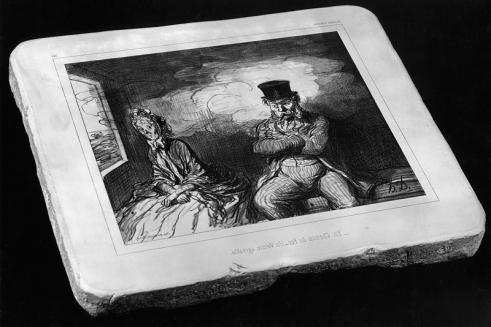
lithographic stone
It controls the diffusion and thus its commercial value. More drawings are, the less each is worth. Plus they are rare, plus the value of each unit increases. It may even prevent additional prints lining the plate, breaking the stone or destroying the negative. The creator, since it enjoys a certain popularity, can maximize their income by managing the balance between original works and multiples, including controlling the spread and the price thereof. Jean-Leon Gerome at the end of the nineteenth th century, is often given an example of control of control of the original works and their derivatives , but it is not the first. The Dutch Golden Age had preceded him by producing prints in addition to their work as a painter. Jeff Koons and Takashi Murakami, in our time, do not proceed otherwise.
In digital art, there is always a matrix - usually a digital file - but the process requires no technical realization. Is the matrix itself is provided. In charge of customer amateur [2] to materialize through the use equipment undercover [3] . Spreading the finished product is therefore also spread the possibility for any buyer, to rebroadcast and, therefore, to manage the business value and deprive the creator of his due reward. Attempts to lock the process of copying or redistribution were numerous. The most sophisticated techniques that do not stand very little time to the ingenuity of hackers amateurs.
The problem is well posed: the creator of a digital work and robs it renounces his compensation, since it diffuses. Digital art moves definitively the debate, passed on the will of the work to that of its commercial value and reward of the artist or his successors- rights.
This new situation calls for new solutions for the artist to be paid for his work creation, even if only to give him the means to continue his work. Four main models are emerging.
- A model consummation aristocratic.
In this model, the artist sold his digital work as if it were an original, at a price that reflects this uniqueness. The buyer is free to make as many copies as they wish, knowing that by doing so, it helps to reduce the commercial value of its acquisition, transforming a unicum multiples. This pattern of diffusion layer that unique works, ignoring the question of reproduction, an issue that may arise elsewhere too quickly for non-digital works. Indeed, with the development of photocopiers, the question will inevitably arise from the difference between a drawing called original and its copy, exactly the same, indistinguishable.
This model does not renew the client works, just taking into account the digital phenomenon. It is also more or less, the pattern that prevails today for the dissemination of video art. We stay in a generally elitist preserving the status quo processes of creation and dissemination of the work. The mechanism of seduction, inherent in any attempt to sell an artwork, remains unchanged.
- A model popular consumption.
In contrast, the artist seeks mass distribution of its creation. The idea is to set a price such that the process of illegal copying has no more economic sense for the potential fraudster. It is the model put forward by Apple for distributing its applications for iPhone or by some platforms that offer custom ringtones for mobile phones. What good contrive to hack an object that only costs a few euros? The model is here that the mass distribution, with the aim to attract the greatest number.
This scheme, for it has an economic sense, requires a broader base of potential customers. It has necessarily an impact on the nature of the works offered. It does not seduce the mass with the same weapons as the circle of insiders fans.
- A model free .
Like Internet sites that offer free services but are financed by proposing banners paid services to third parties, the digital artist can opt for free works by rewarding it broadcasts, indirectly, through income-related. These can be endogenous or exogenous.
In the first case, the artist will encourage his client to invest in one of his non-digital, conventional. The technique is here that the teasing : arouse desire and acting out.
In the second case, the income will come from services independent of the work: subscriptions to art magazines, purchase of supplies or services outside the artistic sphere. In its most basic form, it will be the establishment of a roster of qualified addresses salable to others. It is here in the sphere of conventional Internet marketing .
- A model subscription.
Publishers On the model of micro-computer software packages that have given up the fight against piracy, but still maintain their income through a policy of successive versions of their products, one can imagine, in this model, that the sale of a digital work gives the holder, uniquely identified by its address, the ability to evolve its acquisition, give him, somehow, a third dimension, time. The key to success is, in this model, the ability to maintain customer interest for a long time, maintaining his desire.
we can see, the stakes are significant and require digital artist working in another dimension, to act to maintain the momentum of its buyers well beyond the phase initial seduction. The digital work, even static, must incorporate erosion factors, addiction, habit, and lassitude, to continue to seduce. In addition to its creative dimension, a willingness to experiment, to discover terrae incognitae , the artist must also implement digital marketing, but marketing repeated with every new work. Marketing of up to merge with the essence of the digital work.
 Drawing on downloaded digital epaper
In digital art, everything is still possible. Everything is invented or reinvented, in a world where fun has a role to play, opening on unexplored worlds. And in these new worlds, never the creative process and showing or broadcasting of the work have been so intertwined, inseparable.
[1] In reference to the work of Georges Bataille, The Accursed Share , test Economy General , 1949, which highlights the concept of destruction and loss the consummation aristocratic, as opposed to the rationalization of expenditure bourgeois consumption.
[2] One could imagine that the creator itself controls the materialization of his work, by providing, for example, paper prints. This would not be in this case, digital art, but simply, like photography, using digital techniques to produce works of art conventional .
[3] not forget that the e-paper in color and 3D printers capable of producing objects by volume, are already or will soon be available. The inevitable reduction in costs of these facilities will make them more readily accessible to the greatest number.

 Chopsticks "my way" with sunflower seeds and sesame golden


 Source: Recipe Me